Holding the wheel
Notes from the 2026 MS Ride
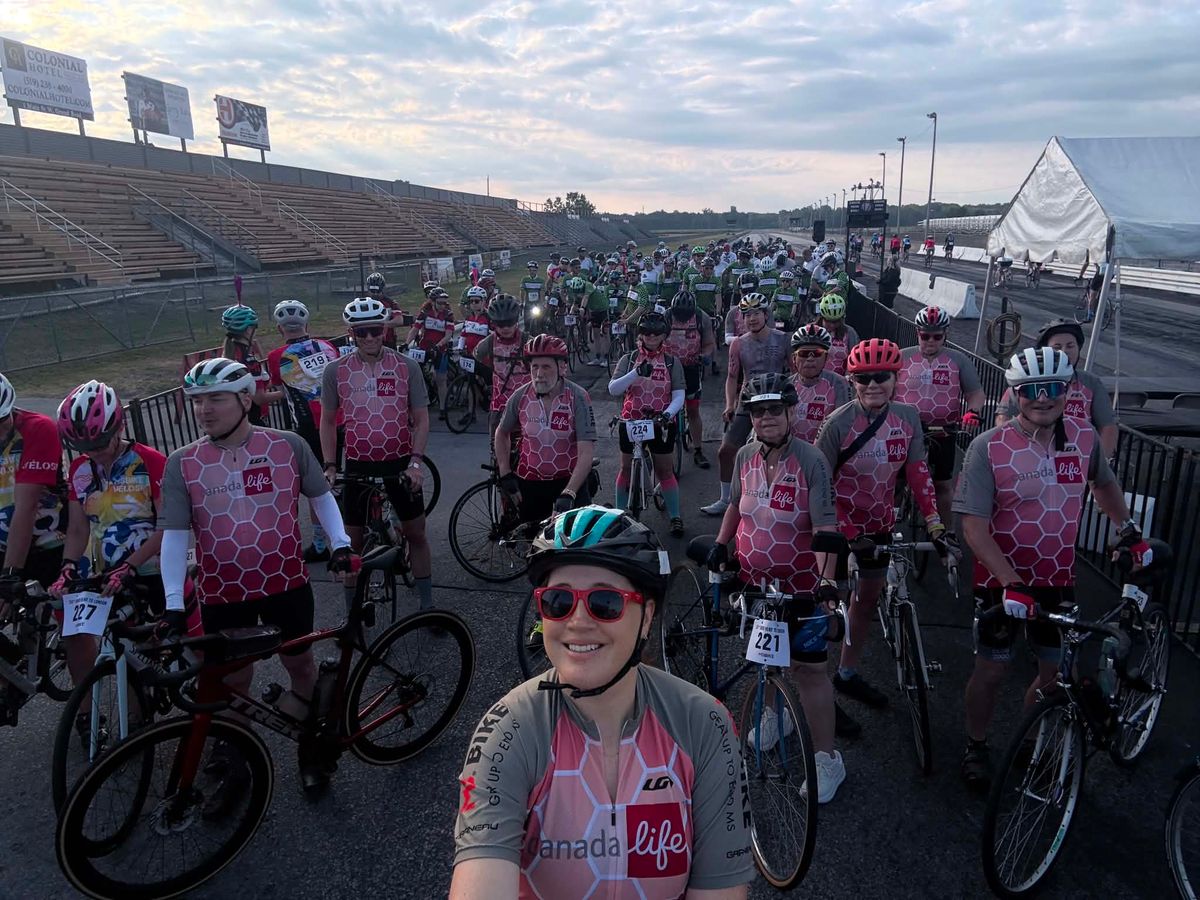
Natalie had her best MS Ride this year.
She started training in May. We lifted weights, swam, and rode together. My own rides run longer, mostly because I sign up for distances a sensible person would decline. She'd usually turn for home while I kept going, which tells you which of us has the better judgment.
We talked about our rides constantly. Somewhere in there, we traded. She borrowed my appetite for getting on a bike, and I borrowed her discipline for lifting heavy things and putting them down again.
We weren't the only ones doing that.
Many of the people who do the MS Ride wouldn't describe themselves as cyclists, not really. They do the MS Ride once a year, then the bikes go back in the garage until next May.
They still show up for training rides through the early summer, though, because their friends do too. They wait for each other at the top of a hill. They tell each other the worst of it is over, or that the wind will die down after the next turn, which it never does. By the time the actual event arrives, most of them can ride farther than they could in the spring, and none of them did it alone.
That's the part of the MS Ride nobody puts on the poster. The money matters; our team crossed six figures this year. So does waiting for a friend at the top of a hill.
That's usually how it works. You wait for the slower rider. On the way home from Grand Bend, I found out what it's like to be the slower rider.
He caught up to me in London at the end of day one. I could tell he was fast. He was compact, built like a jockey who'd wandered into the wrong sport. He raced crits, chased Ontario Cup points on weekends, and was, best I could tell, born sometime this century, which put a solid twenty-five years between his legs and mine.
None of that is really my department. I do longer distances, at a pace that allows for conversation, on the theory that if you can't be fast, you can at least be stubborn. Two hundred kilometers is a light Saturday.
It turned out we had something else in common. I'd ridden to Grand Bend that morning before the event even started, the way I do every year, while Natalie drove down with our friends. He'd done the same. Almost nobody does that.
At the end of day two, back in Grand Bend, he found me again. He was riding home to London after, he said. Was I?
I knew I was in trouble.
We left Grand Bend together. The road out of town was a mess of weekend traffic and beach-goers, everyone drifting a little closer to cyclists than they should, and he put in an effort to get us through it. It was like he'd been fired from a cannon. I barely held on.
Holding the Wheel (verb phrase)
/ˈhoʊldɪŋ ðə wiːl/
- Tucking in close enough behind another rider to borrow their effort.
- The entire physics of the peloton, dressed up to sound less like freeloading and more like strategy.
Once we cleared the traffic, he found a pace he could talk through. It happened to sit right at the edge of what I could hold and talk at the same time. So the conversation went the way conversations go when one rider is working harder than the other: my questions got shorter, his answers got longer. He talked about his coach and the season he was building toward. I mostly listened, which is unusual for me, and made a small collection of noises meant to suggest I was still capable of forming opinions.
Somewhere past Ilderton I noticed I'd stopped checking my speed. I wasn't managing the effort the way I usually do on my own, rationing it out over the distance of an event. I was just trying to stay on his wheel a little longer.
By the time we reached the outskirts of London, I had stopped thinking about the ride entirely. I had started thinking, the way I always do when my legs run out of things to say, about dead philosophers.
Aristotle thought there were three kinds of friendship. Most of ours are friendships of utility or pleasure: the guy at the bike shop who always has the parts you need in stock, the friend you only ever see at parties. Nothing wrong with either. But he set those apart from a third kind, built on virtue, where the good in one person recognizes the good in the other. He thought that kind of friendship was rare, and that it changed you, slowly, just by being in it.
I'd always read that as a nice idea about picking good company. Holding on to someone else's wheel, I decided I'd had it slightly wrong. It isn't about finding people who already share your values. It's about finding someone whose pace you have to grow into, and discovering, a few kilometers later, that you did.